Some links on this page are affiliate links. If you click through and make a purchase, we may earn a small commission at no extra cost to you. This helps us maintain and improve this independent guide. Learn more.
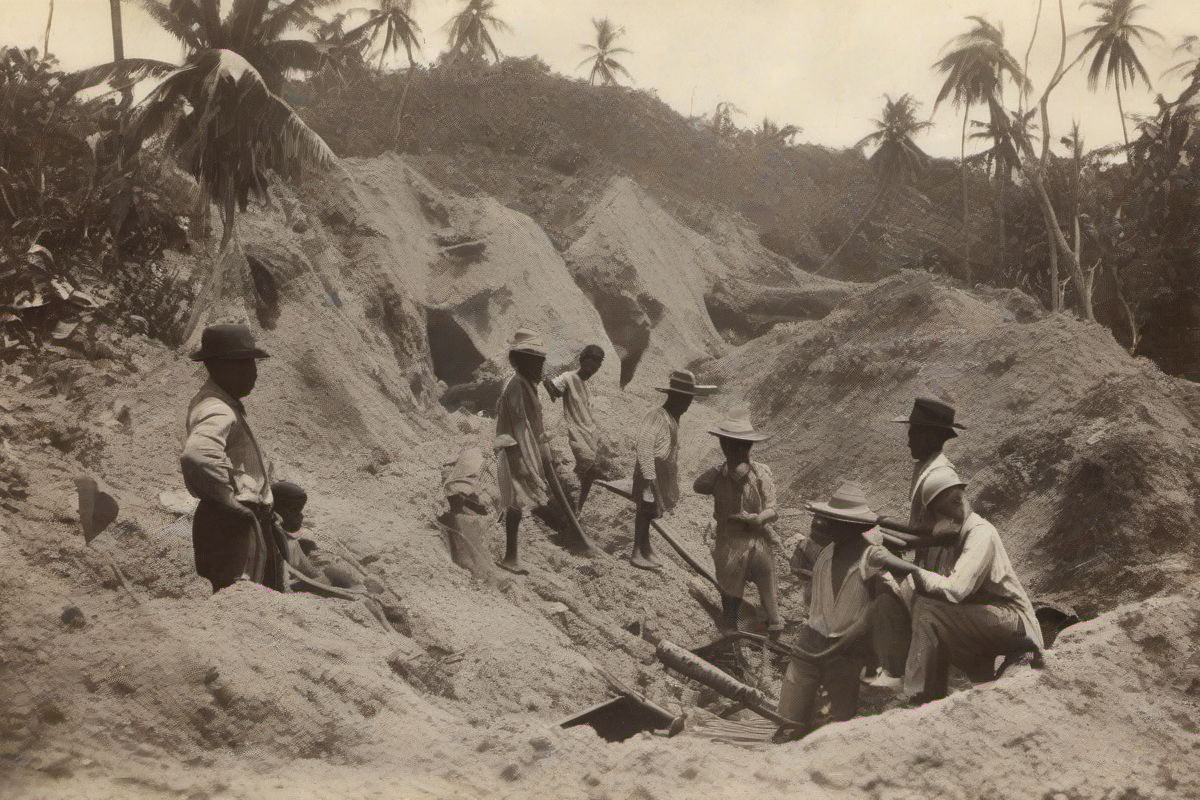
Nauru's history spans over three millennia, from the first Micronesian navigators who crossed the vast Pacific Ocean in outrigger canoes guided by the stars and ocean swells, through the upheavals of colonialism and world wars, to its emergence as the world's smallest independent republic in 1968. Few nations of any size have a story as dramatic — a narrative of boom and bust, survival against overwhelming odds, and a people whose language, culture, and identity have endured through every challenge history has thrown at them.
Pre-Colonial Era — The First Nauruans
The first people arrived on Nauru approximately 3,000 years ago, crossing the Pacific from the Caroline and Marshall Islands in voyaging canoes. These early Micronesian settlers brought with them the Austronesian language that would evolve into modern Nauruan (Dorerin Naoero), advanced navigation knowledge, fishing techniques, and a rich oral tradition. They established the 12 original tribes — Deiboe, Eamwit, Eamwitmwit, Eano, Eaoru, Emangum, Emea, Irutsi, Iruwa, Iwi, Ranibok, and Rengab — each with its own territory, chief, and customs.
Nauru's isolation allowed a unique culture to develop largely undisturbed for centuries. The society that flourished was based on fishing, coconut cultivation, breadfruit harvesting, and the careful management of limited land and freshwater resources. Inter-tribal relations — including marriages, trade alliances, and occasional conflicts — shaped the island's political landscape. This traditional way of life persisted until European contact in the late 18th century.
Timeline of Key Events
~3000–1000 BCE — First Micronesian Settlers
The first people arrive on Nauru by outrigger canoe from the Caroline and Marshall Islands. They bring with them Micronesian language, navigation knowledge, and a culture centered around the ocean. These early settlers establish the 12 original tribes that would define Nauruan society for millennia.
~1000 CE — Tribal Society Flourishes
Nauru's 12 tribes — each with their own chief, territory, and traditions — develop a complex society based on fishing, coconut cultivation, and breadfruit harvesting. The island's isolation allows a unique culture to evolve undisturbed. Inter-tribal negotiations and marriages shape the political landscape.
1798 — "Pleasant Island" Discovered
British whaling captain John Fearn becomes the first European to sight Nauru, naming it "Pleasant Island" for its welcoming appearance. Fearn's encounter is brief, but it marks Nauru's entry into the European record. Whaling ships occasionally visit for fresh water and supplies in the following decades.
1830s–1880s — European Contact Era
European whalers, traders, and deserters begin regular visits. Firearms and alcohol are introduced, disrupting the traditional tribal balance. A brutal internal war erupts in 1878, lasting over a decade and decimating the population. In 1888, Germany annexes Nauru as part of the Marshall Islands protectorate to restore order.
1900 — Phosphate Discovered
Albert Ellis, a New Zealand geologist working for the Pacific Phosphate Company, discovers that Nauru's central plateau is composed of some of the richest phosphate deposits ever found — formed over thousands of years from seabird guano. This discovery will transform Nauru's destiny, economy, and landscape forever.
1907–1914 — Early Phosphate Mining
The Pacific Phosphate Company begins large-scale phosphate extraction. The first shipment leaves Nauru for Australia in 1907. Nauruans are employed as laborers, though under strict colonial oversight. Mining infrastructure including a narrow-gauge railway is built across the island.
1914–1921 — World War I & Australian Control
At the outbreak of WWI, Australian forces capture Nauru from Germany. After the war, the League of Nations grants a joint mandate over Nauru to Britain, Australia, and New Zealand — though Australia effectively administers the island. Phosphate mining continues under the British Phosphate Commissioners.
1920 — The Great Flu Epidemic
The 1918 influenza pandemic reaches Nauru in 1920, devastating the population. Approximately 200 Nauruans die — a catastrophic loss for a small population. This event, combined with the earlier tribal war and WWII losses, would later make Angam Day (population recovery celebration) so significant.
1942–1945 — World War II & Japanese Occupation
Japanese forces occupy Nauru in August 1942. The island is subjected to Allied bombing raids targeting the phosphate infrastructure. The Japanese forcibly relocate 1,200 Nauruans to Chuuk (then Truk) in the Caroline Islands, where 500 perish from starvation and disease. Liberation comes in September 1945.
1947 — UN Trusteeship
Nauru becomes a United Nations Trust Territory administered by Australia, New Zealand, and the UK. The Nauruans who survived the Chuuk exile begin returning home. The post-war period sees increased political awareness and calls for self-determination.
1964 — Path to Independence
The Nauru Local Government Council, led by Hammer DeRoburt, begins pressing for independence and control over phosphate revenues. The Council purchases the assets of the British Phosphate Commissioners for AUD 21 million — a bold move that gives Nauru economic leverage.
1968 — Independence!
On January 31, 1968, Nauru becomes the world's smallest independent republic. Hammer DeRoburt serves as the first President. The constitution establishes a parliamentary system with a president elected by parliament. Nauru adopts its flag — a blue field with a yellow stripe representing the equator and a 12-pointed star representing the 12 tribes.
1970s–1980s — Phosphate Boom Years
Nauru enjoys a period of exceptional wealth from phosphate exports, becoming one of the highest-income nations per capita in the world. The government invests globally — in a 52-story tower in Melbourne (Nauru House), hotels in Washington and London, an airline (Air Nauru), and a shipping fleet. Free education, healthcare, and housing are provided to citizens.
1990s — Economic Decline
Phosphate reserves begin to deplete dramatically. Nauru's reckless investments fail — Nauru House is sold, the airline collapses, and the shipping fleet is repossessed. The government turns to unconventional revenue sources including offshore banking and money laundering, leading to international sanctions.
1999 — United Nations Membership
Nauru joins the United Nations as its smallest member state. This marks a significant milestone in Nauru's international recognition and provides a platform for advocating on climate change issues that threaten the island's future.
2001–2008 — Pacific Solution & Regional Processing
Nauru enters into agreements with Australia to host asylum seekers in offshore processing centers. The 'Pacific Solution' provides significant revenue — at times accounting for up to 20% of Nauru's GDP — but also brings international scrutiny over human rights conditions.
2011 — A New Mining Era
Phosphate mining resumes with a secondary deposit estimated to last 20–30 years. New rehabilitation laws require miners to restore mined-out land. The re-opening brings economic relief but also renewed debate about environmental stewardship.
2024–2025 — Strategic Diplomatic Shifts
Nauru makes international headlines by switching diplomatic recognition from Taiwan to China in January 2024, receiving development commitments. President David Adeang leads efforts to secure climate resilience funding and economic partnerships. Nauru actively participates in Pacific Islands Forum climate advocacy.
Post-Independence Era — Challenges and Resilience
Following independence in 1968 under founding President Hammer DeRoburt, Nauru enjoyed two decades of extraordinary prosperity from phosphate exports. The Nauru Phosphate Corporation managed the industry, and the government invested heavily in infrastructure, education, healthcare, and international assets. Nauru House, a 52-story skyscraper in Melbourne, symbolised the nation's wealth and ambition. Air Nauru connected the island to Fiji, Australia, and beyond. Nauruans enjoyed free education through university, free healthcare, subsidised housing, and no income tax.
However, the boom was not to last. By the 1990s, primary phosphate deposits were exhausted, overseas investments failed, and the nation faced an unprecedented economic crisis. Nauru turned to unconventional revenue sources including offshore banking, which led to international sanctions from the Financial Action Task Force (FATF) for money laundering concerns. The early 2000s saw Nauru enter into the 'Pacific Solution' with Australia, hosting asylum seekers in regional processing centres in exchange for significant development assistance — a program that brought both economic relief and international scrutiny over human rights conditions.
Nauru in the 21st Century
Today's Nauru is a nation in transition, navigating the complex legacy of its phosphate past while building a sustainable future. The phosphate wealth that once made it one of the richest nations per capita is largely depleted, leaving behind a landscape of limestone pinnacles on the central plateau and a challenging economic inheritance. Yet Nauru is reinventing itself — as a powerful voice for small island states in the climate crisis, as a steward of some of the Pacific's richest tuna fisheries through the Parties to the Nauru Agreement (PNA), and as a nation actively exploring sustainable tourism, renewable energy, deep-sea mining, and new international partnerships.
In January 2024, Nauru made international headlines by switching diplomatic recognition from Taiwan to the People's Republic of China, securing commitments for infrastructure development and economic cooperation. President David Adeang has led efforts to secure climate resilience funding and economic diversification. Nauru remains an active and respected member of the United Nations (since 1999), the Pacific Islands Forum, the Commonwealth of Nations, and a growing network of international alliances.
The Nauruan people remain at the heart of every chapter of this story — resilient, warm, creative, and deeply connected to their heritage. The 12-pointed star on the flag still represents the 12 original tribes. 'God's Will First' remains the national motto, emblazoned on the coat of arms alongside the frigate bird, the phosphate industry, and symbols of governance. And the spirit of 'Angam' — survival against the odds, returning home, celebrating life — continues to define the Nauruan character as it has for over 3,000 years.
🌟 Angam: The Spirit of Survival
The Nauruan word 'Angam' (also spelled 'Angam') means 'to celebrate' or 'to reach home'. It refers to the survival of the Nauruan people as a distinct community — first after the devastating influenza epidemic of 1920 decimated a population already weakened by a century of European contact, and again after the tragic forced relocation to Chuuk (then Truk) during World War II, where nearly half of the 1,200 deportees perished from starvation and disease. When the Nauruan population reached the critical threshold of 1,500 — considered the minimum for long-term survival as a genetically viable community — the nation celebrated Angam Day. Today, October 26 is one of the most significant dates on the Nauruan calendar, a day of dance, song, traditional ceremonies, and profound gratitude for the endurance of the Nauruan people. The naming of 'Angam babies' — children born in the year since the last Angam Day — symbolises the continued vitality and future of the nation.
Nauru's Flag — A Symbol of Identity
The flag of Nauru, adopted at independence on January 31, 1968, is one of the most meaningful national flags in the Pacific. The blue field represents the Pacific Ocean and the sky. The yellow horizontal stripe represents the Equator, marking Nauru's position just 53 kilometres south of this line. The white 12-pointed star symbolises the 12 original tribes and the island's location in the Pacific. The design is simple, elegant, and deeply tied to Nauruan identity — every element tells a story of geography, heritage, and unity.